What Is a Multifocal Intraocular Lens?
These lenses make it possible to see far and near more clearly. The lenses use different optical powers at different areas across the lens. They rely on the eye muscles to move when necessary to focus. It is best if someone gets the implants in both eyes rather than just one.
These lenses often allow people to stop wearing eyeglasses and contact lenses. On the surface of the lens, there is usually a form of concentric rings etched into it. This allows images at a variety of distances to focus on the retina.
It can take a little time for people to adapt to these lenses. This is because the focusing power the lenses provide is different than what people are used to. The brain needs time to adjust to the new way of focusing.
Multifocal Lenses all work to improve intermediate, far, and near distances. In many cases, after having the lenses implanted, people no longer need to wear corrective lenses to see clearly. The results are usually long-lasting, and there is no upkeep since the lenses are implanted in the eye.
How Does Lens Replacement Surgery Work?
Lens replacement surgery is a very quick, safe and comfortable procedure for the patient.
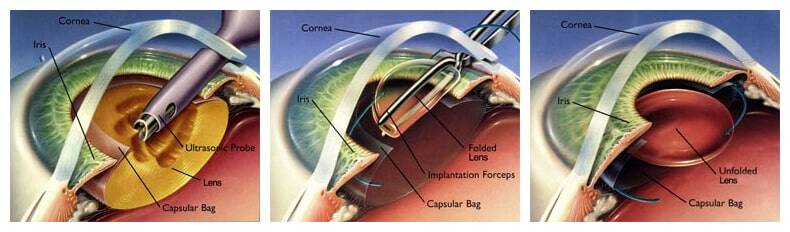
The first step in lens replacement surgery is to sedate a patient, who remains awake throughout the procedure. While the patient lies on his/her back, the eye surgeon makes an incision on the side of the eye.
Next comes the lens extraction process from the front-facing, internal part of the eye, using a phacoemulsification ultrasound probe. “This leaves behind a sac that’s used to hold the human lens in place. Then, a synthetic intraocular lens of choice is implanted into the same sac. This surgery can take anywhere between 15 to 20 minutes per eye.
Once the surgery is over, no stitches are put into the incisions since they will close by themselves. The doctor puts a shield over the eye. After this, people can go home to continue with recovery.
Is Lens Replacement Surgery Painful?
No. Lens replacement surgery is a painless and safe procedure. Prior to the surgery, the patient will receive local anaesthetic to remove all pain sensations during the operation. As the anaesthetic wears off, patients commonly experience some temporary discomfort. In the days following a lens replacement surgery, it is common for the patient to experience mild soreness or itching around the eye but this typically subsides quickly. Generally, medicines for pain relief are fully sufficient to manage any discomfort the patient may be experiencing.
Who Not Qualified for Lens Replacement?
Prior to making a decision on the operation, an analysis of the patient’s general state of health and the results of an examination of his/her visual system are mandatory.
- Age-related macular degeneration
- Diabetic damage to the retina
- Strabismus
- Diseases associated with a violation of the cornea shape
- Uncontrolled glaucoma.
- Advanced dry eye. Any pre-existing conditions need to be treated prior to surgery to ensure good outcomes,
- Weak zonules : They could dislocate if implant lenses in eyes with weak zonular support.
- Previous retinal detachment in either eye.
- A relatively young patient.
- Congenital cataracts and cataracts associated with certain other ocular abnormalities ( recurrent iritis, essential iris atrophy).
- Certain occupations that involve the need for critical night vision, especially if you want Trifocal lenses.
| Feature |
Details |
| Operation Time |
15 to 20 Minutes (Per Eye) |
| Anesthesia |
Topical Numbing Eye Drops |
| Hospital Stay |
Outpatient (Same Day Discharge) |
| Recommended Stay in Antalya |
5 – 7 Days |
| Recovery Period |
24 to 48 Hours
|
Why Choose Antalya for Refractive Lens Exchange (RLE)?
-
Premium Trifocal / Smart Lenses: High-grade FDA-approved lenses providing seamless clear vision for Near, Intermediate (Computer), and Far distances.
-
Permanent Vision Correction: Once implanted, Smart Lenses last a lifetime and prevent future cataract development completely.
-
Painless & Quick Procedure: Micro-incisional surgery performed under local drop anesthesia with rapid visual recovery.
International Patient Journey (4-Step Process)
-
Step 1: Free Prescription & Photo Pre-Screening
Share your current eyeglasses prescription and eye history via WhatsApp or Email for an initial feasibility check.
-
Step 2: Precise Diagnostics in Antalya
Advanced biometry and corneal topography measurements by Dr. Emir Doğan to select the ideal IOL lens power for your eyes.
-
Step 3: The Surgical Procedure
Painless 15-minute lens exchange in a state-of-the-art sterile surgical theater.
-
Step 4: Post-Op Care & Return Flight
Next-day follow-up examination, personalized eye drop regimen, and final clearance before flying back home.
-
Q: What is the main benefit of Lens Replacement Surgery over LASIK?
A: While LASIK reshapes the cornea, Lens Replacement replaces the natural internal lens. It is the ideal solution for patients over 40, those with presbyopia (reading difficulties), high prescriptions, or thin corneas.
-
Q: Will I ever need cataract surgery in the future after Smart Lens Replacement?
A: No. Because your natural biological lens is replaced with a artificial premium lens, you will never develop cataracts later in life.
-
Q: How many days should I stay in Antalya for Smart Lens Surgery?
A: We recommend staying in Antalya for 5 to 7 days. This ensures adequate time for diagnostic measurements, treating both eyes comfortably, and completing post-operative checks.